Introduction: When Study Abroad Doesn’t Go as Planned, It’s Not About Ability or Effort
Studying in Japan is a major challenge for students—and an important investment in their future for parents.
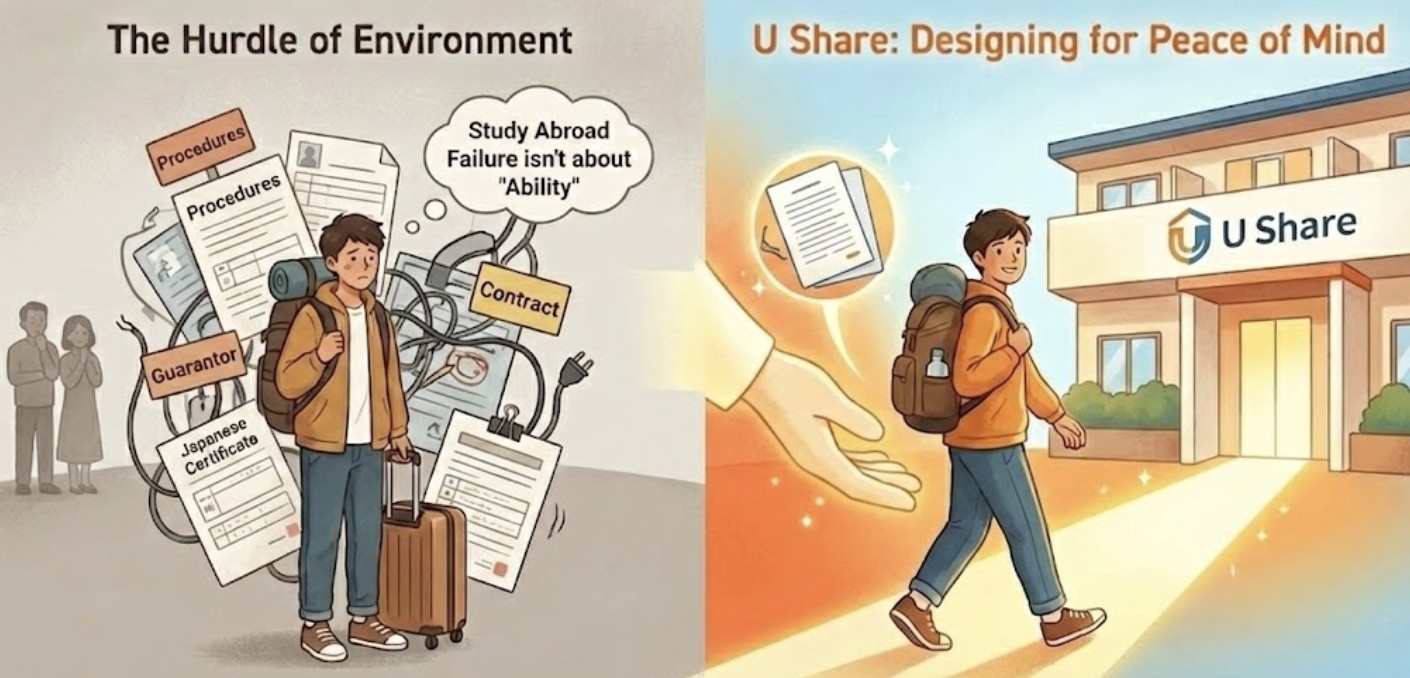
When a study-abroad experience does not go well, it is often assumed that the cause lies in the student’s ability, effort, or adaptability.
In reality, that is rarely the case.
More often, the true cause is the high barrier of Japan’s living environment, which is not designed with international students in mind.
Most students arrive well prepared:
they have studied the language, chosen their academic path carefully, and completed the required procedures.
“It should be fine—we’ve prepared thoroughly.”
Many families arrive in Japan with that confidence.
Yet within just a few weeks or months after arrival, a significant number of international students experience:
Unexpected physical and mental exhaustion
Daily life becoming difficult to manage, leading to growing anxiety
Difficulty concentrating on studies or research
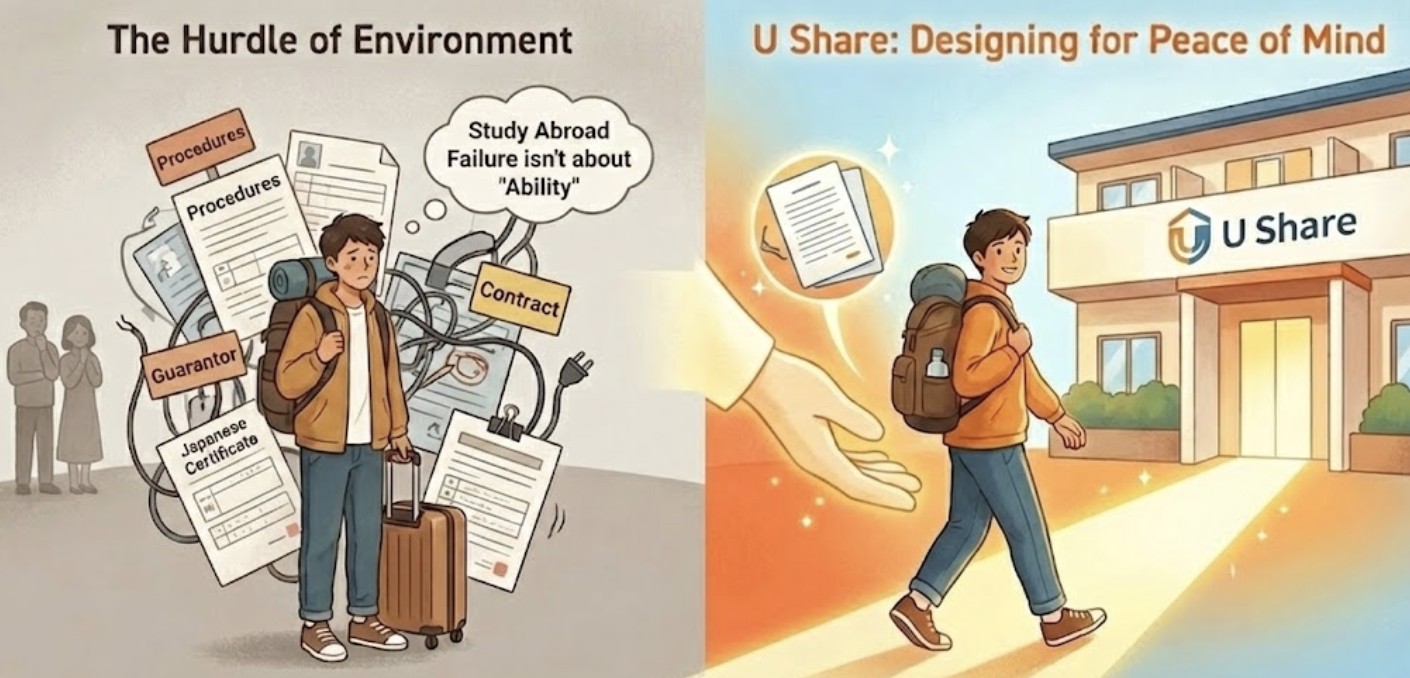
This is not a failure of effort or resilience.
The underlying problem is that Japan’s everyday systems are not designed for students who are new to the country.
U Share begins with this reality and prioritizes one goal above all else:
helping international students establish a stable, stress-free life in Japan from day one.
1. Removing Major Barriers at the Contract and Arrival Stage
Japan’s rental housing system is designed for people who are already living and functioning within Japanese society.
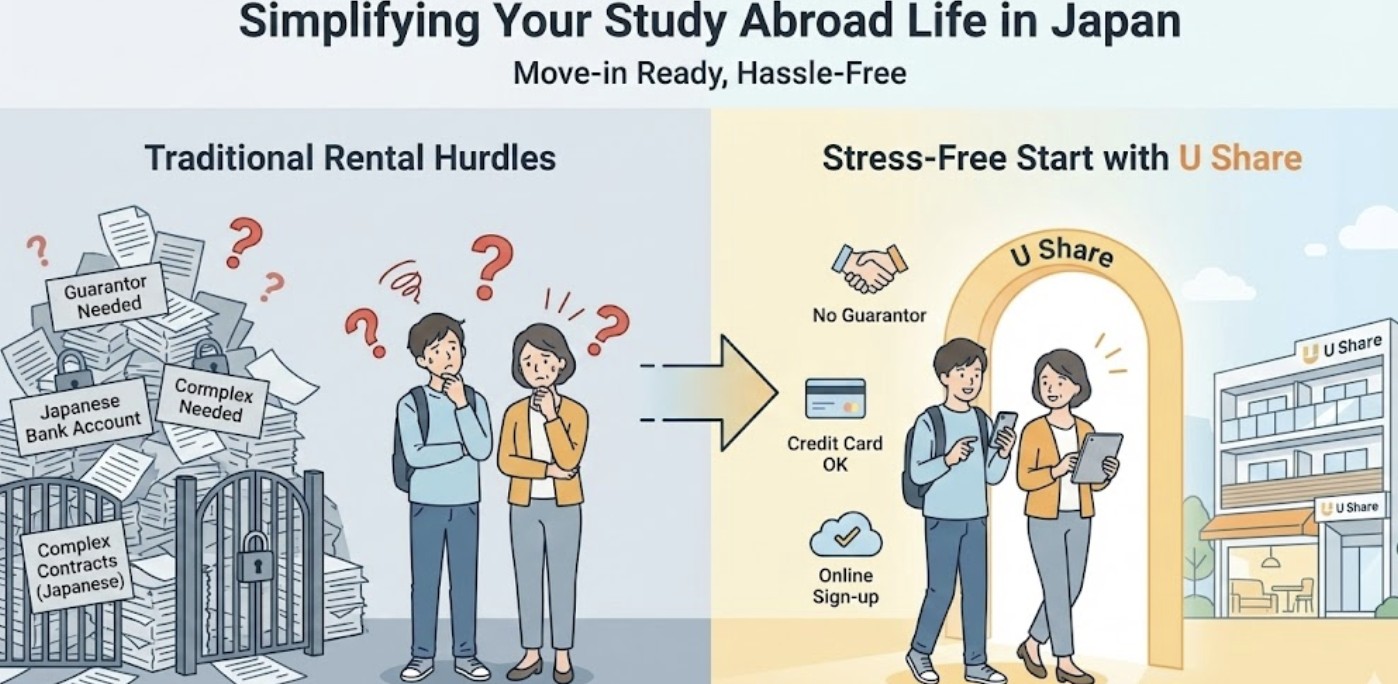
As a result, international students immediately face obstacles such as:
No Japanese guarantor
Long, complex contracts written only in Japanese
No Japanese bank account or credit history
Inability to complete housing contracts before arriving in Japan
At this stage, many students face overwhelming anxiety simply because they do not know where they will live.
U Share is designed specifically for this situation.
Contracts That Work Before and Immediately After Arrival
With U Share:
No Japanese guarantor is required
A Japanese bank account is not necessary
Credit card payments are accepted
All contract procedures can be completed online
There is no need to wait until “after opening a bank account” or “after arriving in Japan.”
The value of not being exhausted by housing uncertainty cannot be overstated.
2. Building a Life Without Carrying Everything Alone
After arrival, international students face many quiet but heavy challenges:
Opening a bank account
Signing a mobile phone contract
Completing municipal and government procedures
Understanding garbage disposal rules and daily living customs
Handling these tasks alone—while dealing with language barriers—places a significant burden on students.
At U Share:
Students can consult about procedures
Japan-specific customs can be clarified immediately
There is always a clear place to ask for help
Simply not having to face “I don’t understand” alone dramatically reduces stress during the early stages of life in Japan.
3. U Share’s Greatest Feature: On-Site Resident Assistants (RA)
学生居住者の中から選ばれたリーダー的存在です。
RAは、
同じ住居に暮らし
同じ生活動線を共有し
留学生の立場に近い目線を持つ
いわば
「少し先に日本生活を経験している先輩」。
運営側の管理スタッフではなく、学生の立場から、生活やコミュニティを支える役割を担っています。
ただの「先輩」ではない、RAという役割
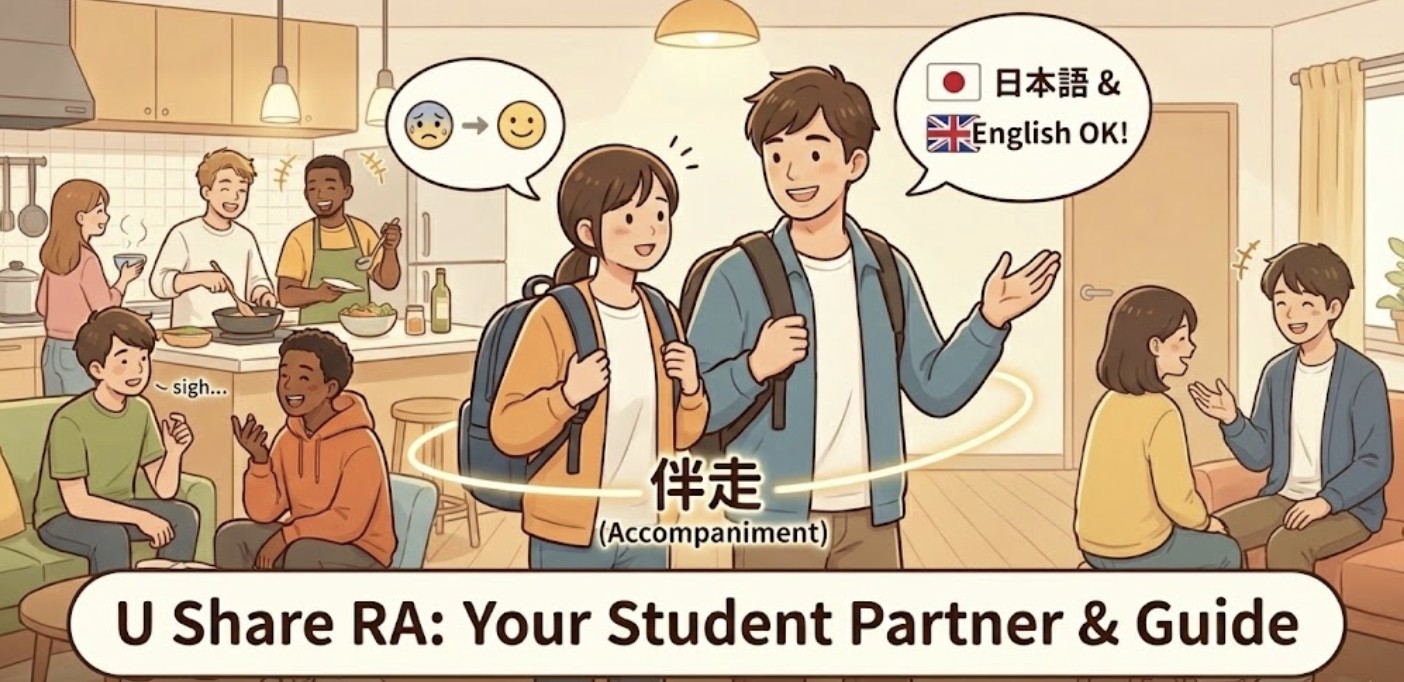
Resident Assistants (RAs) are student residents selected as community leaders.
They:
Live in the same residence
Share the same daily routines
View life from a perspective close to that of international students
They are, in essence, senior students who have already navigated life in Japan.
Unlike management staff, RAs support daily life and the community from a student’s point of view.
4. RA Is Not Just a “Friendly Senior”
Although RAs are chosen from among student residents, they are not simply friends or mood-makers.
At U Share, the RA role is specifically designed to support international students:
Bilingual support in Japanese and English, so language barriers do not prevent consultation
A safe presence for discussing not only daily problems but also relationships and emotional concerns
The ability to notice small signs of discomfort before issues become serious
RAs do not manage or monitor students.
They stay close, offering support at the most natural and effective distance.
“Watching Over” Means Walking Alongside, Not Surveillance
At U Share, “support” does not mean checking or controlling behavior.
Instead, RAs notice:
Everyday conversations
Changes in facial expressions or behavior
Small disruptions in daily routines
They neither interfere excessively nor leave students unsupported.
This balanced presence creates genuine peace of mind.
5. Why “Consulting Only When There’s a Problem” Is Too Late
Problems rarely appear suddenly.
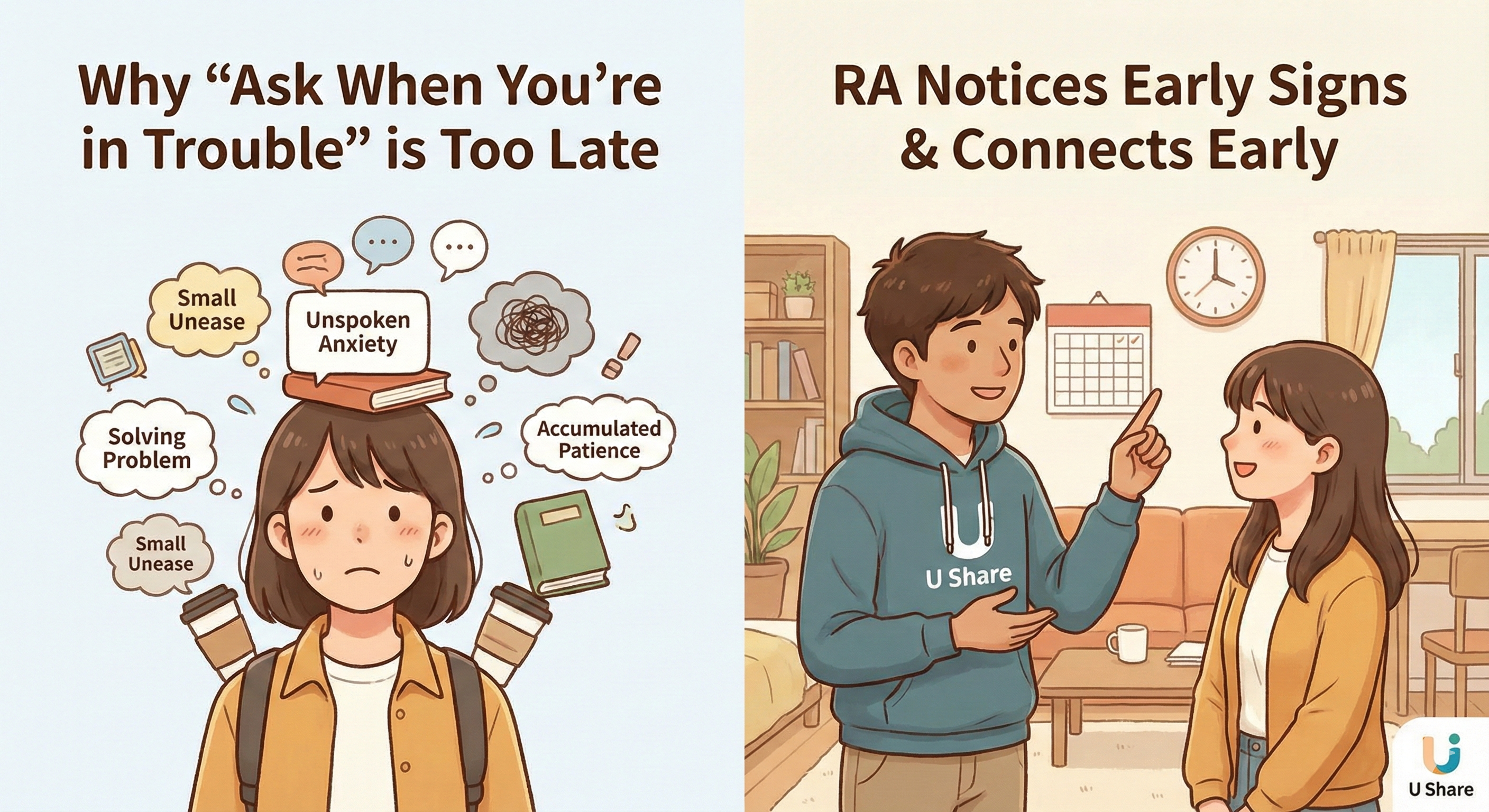
They usually develop through:
Small feelings of discomfort
Unspoken anxiety
Accumulated stress
Because RAs are part of daily life, they can detect early signs through greetings, routines, and behavior.
Support begins before problems escalate.
That is the real value of having RAs on site.
6. Language Barriers Do Not Take Away a Sense of Safety
When problems arise, situations such as:
Not being able to explain clearly in Japanese
Having no one who fully understands the situation in English
can be critical for international students.
U Share’s bilingual RA support ensures:
Accurate communication
Proper understanding of each situation
This seemingly “ordinary” support dramatically increases psychological safety.
7. A Living Environment That Does Not Depend on Japanese Proficiency
Many Japanese living environments rely on:
Unspoken rules
Reading the atmosphere
U Share avoids this by providing:
Clearly documented shared rules
Systems that can be understood even with limited Japanese
A structure designed to prevent conflicts
Students can live comfortably before their Japanese improves.
8. International Exchange Becomes Everyday Life
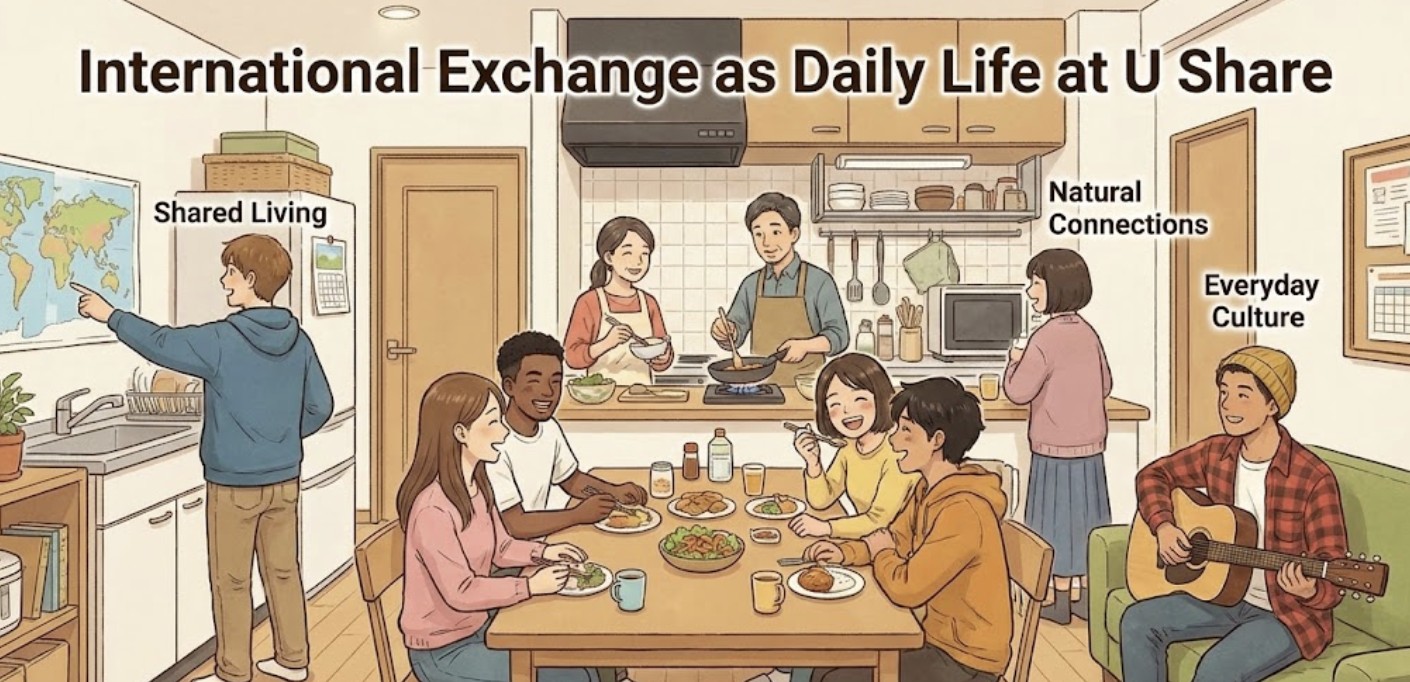
At U Share:
Residents from multiple countries live together
Shared kitchens and living spaces naturally intersect
Daily conversations and cultural friction occur organically
This is not event-based international exchange.
It is continuous, real-life interaction.
What students develop here is not just language ability, but cross-cultural negotiation skills.
9. Preventing Isolation and Supporting Academic Focus
When daily life is unstable, academic performance inevitably suffers.
U Share provides:
Fewer lifestyle troubles
Reduced isolation
Constant access to support
Stable living conditions lead directly to stable academic performance.
10. “Visible Safety” for Parents and Universities
U Share is not a “hands-off” housing model.
Resident Assistants are always present
Clear emergency contact and initial response systems are in place
Students’ living conditions are easier to understand and monitor
For parents living overseas and for host universities, this visibility provides real reassurance.
11. A Rational Choice When Considering Total Cost
U Share may not be the cheapest option by monthly rent alone.
However, when factoring in risks such as:
Housing trouble
Forced relocation
Isolation or early return home
It proves to be a highly cost-effective choice overall.
12. Experiences That Remain Valuable in the Future
Daily life at U Share includes:
Navigating situations with no clear answers
Resolving differences in values
Building consensus
These experiences become stories students can confidently share in their future careers.

Conclusion: U Share Is More Than a Place to Live
U Share is not just housing.
It is infrastructure that:
Stabilizes student life
Prevents isolation
Builds meaningful experiences
It ensures that studying in Japan is not a period of exhaustion—but a time of lasting value.