How much do we really learn outside the classroom? Beyond what lectures and exams measure, there is the question of who you live with, who you talk to, and how you spend your days. There is a way of thinking that treats all of this as education by design. It is called Residential Education, and it is the foundation on which U Share is built, in both its architecture and its programs. Let us trace it back to its origins.

In this article:
- What residential education is
- Origins in the medieval colleges of England
- The house system America inherited
- Japan had its own learning communities
- How design shapes learning
- What the research shows
- What U Share carries forward
- Frequently asked questions
What residential education is
Residential education is an approach that designs the home itself as a place to learn. Rather than confining learning to the classroom, it treats daily life — sharing meals and a roof with people of different values — as a site of education in its own right.
Behind it lies the philosophy of holistic education: the idea of developing the whole person — intellectually, emotionally, socially, physically and spiritually — on the premise that transmitting knowledge is only one part of education.
Whatever form it takes, the common thread is never separating "living" from "learning" — embedding the mechanisms of growth into everyday life.
Origins in the medieval colleges of England
The oldest roots lie in the collegiate system of Oxford and Cambridge. Peterhouse, the oldest college in Cambridge, was founded in 1284 by Hugh de Balsham, Bishop of Ely. The university awards degrees and runs lectures and exams, while the colleges look after residence, dining, small-group teaching and pastoral support — and this two-tier structure is the defining feature.
Students are sharpened through the tutorial (Oxford) or supervision (Cambridge): one-to-one or small-group discussion with a fellow once or twice a week. The communal Formal Hall, where members dine together in gowns, still embodies how life and scholarship are of a single piece.
Incidentally, the Hogwarts houses in the Harry Potter films draw on the house system rooted in British boarding schools. That mechanism of building belonging house by house is itself one expression of an educational culture centred on the home.
The house system America inherited
It was the American philanthropist Edward Harkness who fell for this collegiate model. When his alma mater Yale was slow to accept his proposal, he took the same idea to Harvard. President Lowell accepted at once, and with a gift of roughly USD 10 million, eight Houses were completed in 1931.
A hastily reconsidering Yale received about USD 11 million, giving rise to nine (eventually ten) residential colleges. Princeton, too, built out its residential college system through the late twentieth century. Live-in education is now a standard feature of America's leading universities.
Japan had its own learning communities
The idea of uniting living and learning is not the West's alone. A strikingly close example is Tekijuku, the school of Dutch learning that Ogata Kōan opened in Osaka in 1838. Students lived in a 28-tatami communal room on the second floor — roughly one tatami mat each — poring over scarce imported books and competing for rank through kaidoku, collective reading and debate. From here emerged figures who would shape modern Japan, including Fukuzawa Yukichi, Ōmura Masujirō and Hashimoto Sanai.
The "academy" took other rich forms as well. Yoshida Shōin's Shōka Sonjuku was not residential, yet it welcomed students regardless of social rank and, in just a few years, produced central figures of the Meiji Restoration such as Takasugi Shinsaku, Itō Hirobumi and Yamagata Aritomo. Fukuzawa himself, who rose to head Tekijuku, later founded the academy that would become Keio. The forms differ, but the common thread is the same: a dense community where people debated across the boundaries of status is what raised them.
How design shapes learning
So how should a home be designed to generate learning? Looking across student residences worldwide, they can be loosely arranged by the density of community they create. Treat this less as an established academic taxonomy than as a map for reading design.
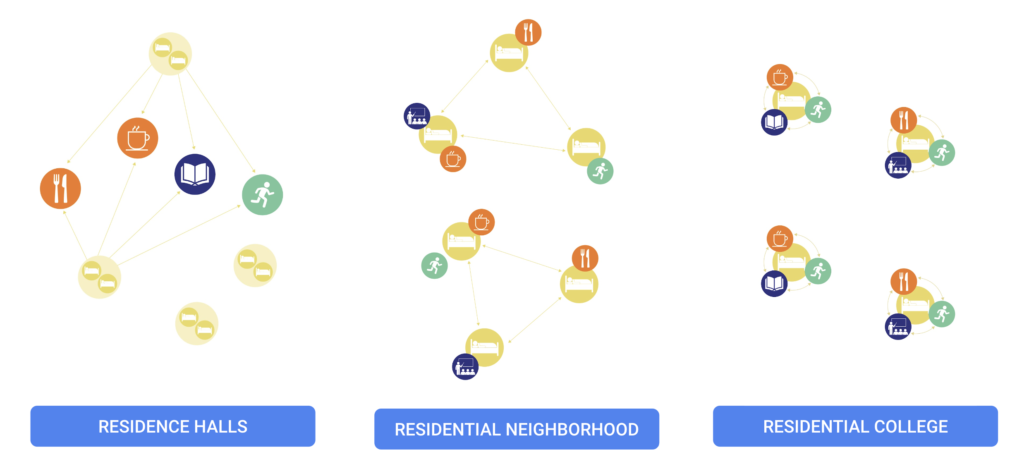
| Model | Spatial character | Community it creates |
|---|---|---|
| Residential Hall | Housing is separated from dining and social facilities; students shuttle between their hall and central amenities | Encounters concentrate at the centre; little incidental contact within the hall |
| Residential Neighborhood | Housing with its own amenities is clustered to form a "district" | Residents stay in one district for years, growing long-lasting ties |
| Residential College | Dining hall, library and more are built into the residence; small and self-contained | People meet daily along shared paths, forming a dense community with strong belonging |
The dining hall's placement is decisive. Simply putting it on the ground-floor path that students walk every day generates the casual "hey, how are you?" exchanges. Architecture designs the encounters themselves.
What the research shows
Evidence for this kind of live-in learning has been accumulating. The large U.S. National Study of Living-Learning Programs (led by Karen Inkelas of the University of Virginia) surveyed more than 40 universities and over 20,000 undergraduates, and found that participants in living-learning programs tend to report a stronger sense of adjustment to university life and of being supported than students in conventional dormitories.
One honest caveat: most of these findings show positive correlation rather than proven causation. Even so, the direction — that who you live with, and how, is bound up with learning and growth — appears consistently across the research.
What U Share carries forward
U Share is designed, in both hardware and software, in light of this 150-year lineage of residential education — from the collegiate systems of Britain and America to the Japanese learning communities in the line of Tekijuku. Circulation that lets conversation arise naturally, a table shared with friends from many countries, and the day-to-day companionship of Resident Assistants (RAs) and Community Managers. To make the place where you live the deepest place of learning in your life — that is U Share's Residential Education.
Quietly hoping that the students who grow up here will one day make some corner of the world a slightly better place, we run this residence again today.
Frequently asked questions
What is residential education?
It is an approach that designs the home itself as a place to learn. Beyond lectures and exams, it deliberately builds everyday experiences — who you live with, what you talk about — into opportunities for learning and growth. It traces back to the collegiate system of Oxford and Cambridge and runs through American universities and the old private academies of Japan.
How is it different from an ordinary dormitory?
Where an ordinary dormitory offers "a cheap place to live," residential education designs the whole of living as learning. Through architecture that sparks interaction, a multinational community, the companionship of Resident Assistants (RAs) and Community Managers, and regular events, living itself is intended to lead to growth.
How does U Share practise residential education?
U Share practises it through shared spaces designed so conversation arises naturally, a multinational community of residents from around the world, bilingual (Japanese and English) support from RAs and Community Managers, and events that encourage learning and exchange. For more, see the U Share Student page.